Designing with water: A climate-resilient village park for Grobbendonk

At the heart of Grobbendonk, a shared challenge formed the starting point for the transformation of the area: how can a village’s green core continue to serve everyday life, serve as a social anchor for intergenerational activities, while responding to growing climate pressures? The transformation of this central site became an opportunity to rethink what resilient public space can be.
POLO Urbanism’s vision starts from a simple but powerful idea, treating water not as a limitation, but as a structuring force for public life. By weaving stormwater management into an open, multifunctional landscape, the park is reshaped as a sponge landscape where ecology, play, and social use reinforce one another, redefining the village commons as a resilient and inviting place for the future.


A sponge landscape for a resilient future
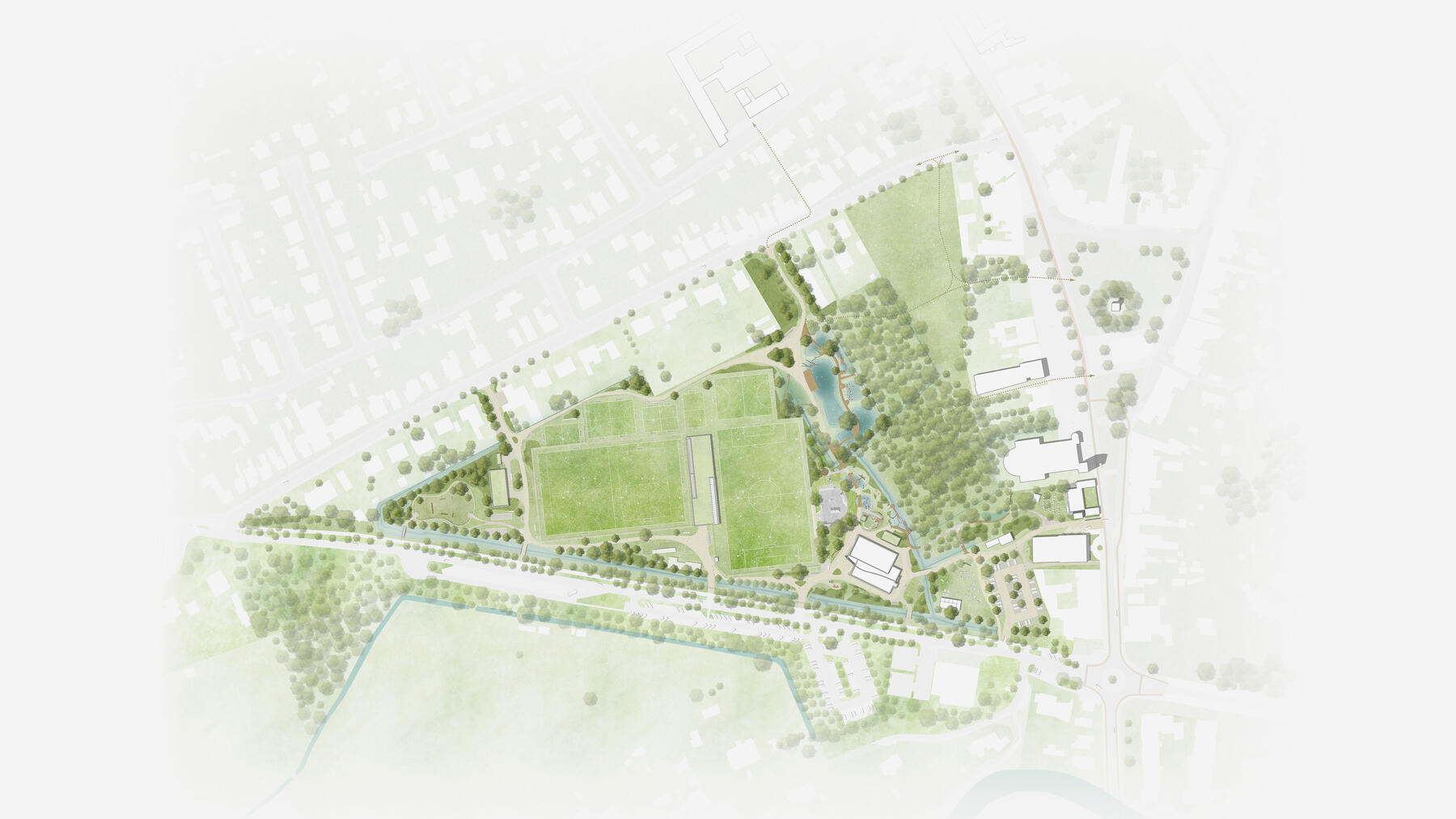
Located in a flood-sensitive zone, the site plays a key role in Grobbendonk’s climate adaptation strategy. The masterplan puts water first, deploying a layered hydrological system composed of dynamic wadis, retention ponds, permeable surfaces, and overflow zones. Together, these elements transform the park into a living water infrastructure that retains, delays, and infiltrates stormwater while enriching the public experience.
This system is not hidden underground; it is celebrated above ground. Water features are integrated visibly and playfully into the design, shaping topography, guiding movement, and turning the experience of weather into a civic, educational, and sensory event.
Each layer of the park’s design has been strategically positioned to serve multiple roles, underlining the value of open space. The same meadow is a picnic space, a seasonal event ground, a play field, and an ecological corridor. The flexible infrastructure invites citizens to use the space in various ways, transforming the park into a resilient public space that evolves with its community.
In line with previous work done for Grobbendonk, the emphasis lies on connectivity, not just between places, but between people. By stitching together, the dispersed pieces of Grobbendonk’s social life, the park becomes not just a destination, but a social connector, rooting everyday activity in the shared green space of the village.


Developed to grow in phases
To allow the municipality the time and space to transform the park in a pace that suits them, POLO Urbanism structured the park around six subprojects.

A blueprint for climate-resilient village cores
Grobbendonk’s new landscape park sets a precedent for how smaller towns can build climate resilience through public space design. Instead of resisting natural conditions, this project adapts to and celebrates them, making water a civic and ecological protagonist in the story of place.
With water as its guiding principle, the park emerges not just as a response to climate risk, but as a new kind of village commons: performative, inclusive, and deeply rooted in the realities, and opportunities, of its environment. While working around a central premise to establish a continuous slow mobility network, linking the park with surrounding neighbourhoods and key public functions.