Thomas More

The overall masterplan for the campus mandates the big building complex at the heart of the campus to be bisected by a new landscape axis, organising the site and providing access to a central green square, the main gathering space for students. The lobbed-off building wing is being completely rebuilt to form a Living Campus Gebouw for the University of Leuven.
What remains on the other side of this axis is a sprawling three-pronged floor plan, occupied by the Thomas More University of Applied Sciences. In close dialogue with the client we establish that the building structure is largely fit for purpose but in need of a comprehensive upgrade, with spatial and programmatic modifications necessary to accommodate current and future needs. Our interventions are strategic and essential, aimed at restoring clarity, sustainability and efficiency to a historically compromised building. We embrace the functional and transform the dysfunctional.

Legible circulation
The circulation diagram with double-sided corridors remains basically the same. We improve orientation throughout the building by locally widening the long corridors, creating space for spontaneous meetings and informal interactions. To further enhance way-finding we collaborate with our POLO Interior Design team to develop a material palette for interior spaces, giving clear colour identities to the different departments.
Existing vertical circulation cores are integrated in our fire compartmentation strategy, proving sufficient to meet evacuation requirements. We enlarge the central lobby space at the confluence of the three building wings and open up the enclosed staircase there. This functions as an open invitation to explore the building, establishing a legible spatiality.
Based on a detailed analysis of the building programme and the available areas, we suggest a construction phasing which minimises disruption to academic activities and limits the need for any temporary container accommodation to be provided on-site.


A new face, a sustainable skin
The existing building structure is essentially fit for purpose, following a base 7.2 m grid module and 4.2 m floor to floor heights. Yet its outside appearance, a messy collage of additions and alterations, belies these rational underpinnings. To improve both image and energy performance, we propose wrapping the existing solid façade in two layers: a thermal insulation layer and a cladding of corrugated metal panels.
This new skin wraps around the various protrusions and extensions of the façade, absorbing all imperfections and later additions, thus providing a coherent and clear new building image. The pronounced horizontal articulation of the panels is in keeping with the linear proportions of the building volumes and provides a pleasing counterpoint to the verticality of the future Living Campus Gebouw next door. By having all corrugation angled, we avoid dust accumulation on horizontal surfaces.
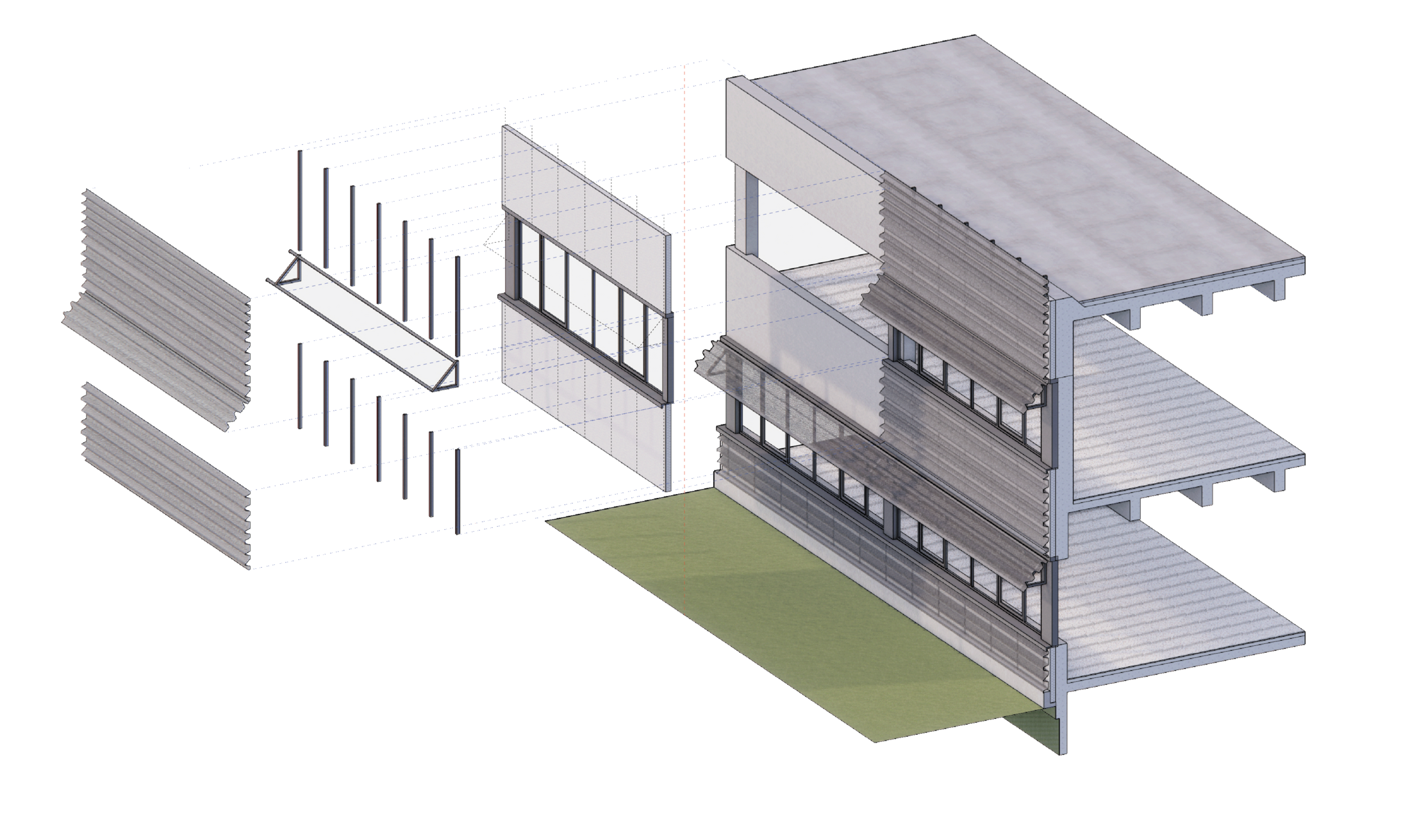
We free up the continuous band of horizontal strip windows, maximising window surface area in order to bring daylight into the deep floor plans. Accommodating flexible internal layouts, windows can be replaced locally by solid panels which provide a straightforward connection to partition walls. The corrugated façade panels fold away from the façade above the windows, forming fixed awnings that protect from high-angled summer sun.
Several strategies are examined to insulate the V-shaped corten steel structure of some of the roofs. Options range from a complete wrapping of the structure to more intricate interventions which retain the characteristic profile.
Our strategic design approach gives a new lease of life to a building which may look worn-out but is structurally sound and inherently functional. Building upon a functional casco base, we optimise circulation, appearance and sustainability, preparing the building for decades more of intense student use.